
Research
Journal papers, conference papers, my Ph.D. dissertation, and talks.
-
Modeling and Design Optimization of Looped Water Distribution Networks using MS Excel: Developing the Open-Source X-WHAT Model
Water Resources Management
PaperPreprintAbstract
Cost-effective water distribution network (WDN) design with acceptable pressure performance is crucial for the management of drinking water in cities. This paper presents a Microsoft Excel tool to model, simulate, and optimize WDNs with looped pipelines under steady-state incompressible flow simulations. Typically, the hardy-cross method is applied using spreadsheet calculations to estimate discharges. This method requires mass-conservative initial estimates and requires successive iterations to converge. In this paper, however, we develop an alternative method that uses the built-in solver capabilities of Excel, does not require initial mass-conservative estimation, and is free of flow corrections. The main objective of this paper is to develop an open-source accessible tool for simulating hydraulic networks also adapted for teaching and learning purposes. The governing equations and the mathematical basis for the hydraulic modeling of the system are mathematically described, considering the topology of the network, mass and energy conservation, cost of tank material, foundation, and cost of pumping energy to fill the tank. The use of this tool is encouraged at the undergraduate and graduate engineering levels, as it offers the opportunity to address complex concepts in a comprehensive way using a spreadsheet that does not require coding expertise. Hence, users can debug all cells and understand all equations used in the hydraulic model, as well as modify them. To demonstrate the model capabilities, three practical examples are presented, with the first one solved step by step, and the results are compared with the EPANET and with the results reported in the literature. Using the optimization method presented in this paper, it was possible to achieve a cost reduction of 151,790 USD (9.8% of the total cost) in a network that supplies a 44,416 population.
-
Influential Pipes in Water Networks
IEEE 64th Conference on Decision and Control (CDC)
PaperAbstract
Water distribution networks (WDNs) are aging infrastructure networks that are susceptible to various failures, including human errors, malicious cyber-attacks, pipe bursts, and leaks. This necessitates vulnerability analysis of WDN topologies and hydraulic models that capture the network physics. Graph-theoretic centrality measures—as a primary class of centrality measures in network science—aim to rank the network components solely based on their influence on the WDN topology in the case of changes, while overlooking the WDN dynamics. To overcome such a limitation, this paper uses a control-theoretic centrality measure to identify the network’s most and least influential pipes in WDNs, by simultaneously incorporating the dynamics and topology of the WDN. We introduce a node centrality-based measure, namely vulnerability vector (VV), to rank the network pipes based on their influence on the dynamics and topology of the WDN in the case of changes. This approach enables water system operators to better understand the network’s vulnerabilities and effectively prioritize the maintenance and operational efforts on the most influential pipes.
-
Control Node Placement and Structural Controllability of Water Quality Dynamics in Drinking Networks
Water Resources Research
PaperAbstract
Chlorine, the most widely used disinfectant, needs to be adequately distributed in water distribution networks (WDNs) to maintain consistent residual levels and ensure water safety. This is performed through control node injections at the treatment plant and via booster stations scattered in WDNs. While previous studies have applied various optimization metrics for booster station placement, many have failed to consider the coverage of the station injections and the dynamic nature of WDNs. In particular, variations in hydraulics and demand significantly impact the reachability and efficacy of chlorine injections which then impact optimal placement of booster stations. This study introduces a novel formulation that combines control- and graph-theoretic approaches to solve the booster station placement problem. Unlike traditional methods, our approach emphasizes maximizing the system's ability to control disinfectant levels with minimal energy, taking into account the time-varying hydraulic profiles that lead to different optimal station placements. We propose a simple weighting technique to determine the placements by assessing the structural controllability of each configuration, based on the network's topology and independent of specific parameters like decay rates or pipe roughness. This method ensures effective chlorine coverage across the network. Our approach is validated on different networks, demonstrating its operational effectiveness, scalability, and practicality.
-
Observability and Generalized Sensor Placement for Nonlinear Quality Models in Drinking Water Networks
Journal of Water Process Engineering
PaperAbstract
This paper studies the problem of optimal geographic placement of water quality (WQ) sensors in drinking water distribution networks (WDNs), with a specific focus on chlorine transport, decay, and reaction models. Such models are traditionally used as suitable proxies for WQ. The literature on this topic is indeed inveterate, but has a key limitation: it utilizes simplified single-species decay and reaction models that do not capture WQ transients for nonlinear, multi-species interactions. This results in sensor placements that do not account for nonlinear WQ dynamics. Furthermore, and as WQ simulations are parameterized by hydraulic profiles and demand patterns, the placement of sensors are often hydraulics-dependent. This study produces a simple algorithm that addresses the two aforementioned limitations. The presented algorithm is grounded in nonlinear dynamic system sciences and observability theory, and yields sensor placements that are robust to hydraulic changes. Thorough case studies on benchmark water networks are provided. The key findings provide practical recommendations for WDN operators.
-
Controllability Gramians Make Water Safer: Water Quality and Hydraulic Regulation in Drinking Networks
American Control Conference (ACC)
PaperAbstract
The operation and regulation of water distribution networks is a complex procedure aimed at efficiently supplying consumers with sufficient water while ensuring its safe quality. A critical aspect is the direct impact of the network’s hydraulics on the dynamics of water quality; the former is typically needed to inform the latter. Previous studies have tackled hydraulic optimization and water quality regulation as separate problems, although they are naturally coupled. While some attempts have been made to couple these problems into a single one, such studies have neglected control-theoretic virtues of the integrated problems. This paper fills this research gap by formulating a pump control problem that accounts for water quality controllability via classic Gramians. This is achieved by integrating water quality controllability metrics into the control problem, the goal is to enhance both water quality regulation and reducing pumping costs. A case study is presented to illustrate that utilizing controllability Gramians leads to an improved overall system performance.
-
Monitoring and Control of Quantity-Quality Dynamics for Resilient Drinking Water Networks
Ph.D. dissertation, Vanderbilt University
DissertationAbstract
The operation of drinking water distribution networks (WDNs) involves complex processes aimed at delivering sufficient water quantity while preserving its safety. These processes are governed by hydraulics and water quality (WQ), with hydraulics focusing on maintaining adequate pressure for efficient delivery and supply, and WQ ensuring compliance with safety standards. The objective of this dissertation is to address the challenges inherent in managing hydraulics and WQ within WDNs through a holistic monitoring and feedback control framework. This framework is based on: (i) advanced WQ modeling of the system's disinfectant (i.e., chlorine), incorporating nonlinear multi-species dynamics for a more realistic representation of real-world scenarios, including contamination events; (ii) acknowledging the dependency between the hydraulic and WQ dynamics and analyzing its influence on system performance, and using these insights to guide; (iii) the development of a joint control approach with the objective of obtaining optimal hydraulic settings while attaining an adequate level of chlorine control coverage across the system; and (iv) control-oriented strategic placement of actuators and sensors to maximize the performance of the monitoring and control computational algorithms while ensuring responsiveness and adaptability to dynamic conditions. This framework bridges significant research gaps in the literature, which often rely on oversimplified single-species WQ models, treat hydraulic optimization and WQ regulation as independent problems, or couple these problems without performance guarantees, leading to trade-offs between objectives. Additionally, traditional methods for determining actuator and sensor placements often prioritize specific objectives, such as cost minimization or simplified design, without considering their influence on the system's controllability, observability, and overall operational efficiency. The presented computational algorithms are validated through different case studies, demonstrating their operational effectiveness, practicality, scalability, and contribution to enhancing the resilience of WDNs in the face of dynamic and uncertain challenges.
-
Climate Science and Control Engineering: Insights, Parallels, and Connections
PreprintAbstract
Climate science is the multidisciplinary field that studies the Earth's climate and its evolution. At the very core of climate science are indispensable climate models that predict future climate scenarios, inform policy decisions, and dictate how a country's economy should change in light of the changing climate. Climate models capture a wide range of interacting dynamic processes via extremely complex ordinary and partial differential equations. To model these large-scale complex processes, climate science leverages supercomputers, advanced simulations, and statistical methods to predict future climate. An area of engineering that is rarely studied in climate science is control engineering. Given that climate systems are inherently dynamic, it is intuitive to analyze them within the framework of dynamic system science. This perspective has been underexplored in the literature. In this manuscript, we provide a tutorial that: (i) introduces the control engineering community to climate dynamics and modeling, including spatiotemporal scales and challenges in climate modeling; (ii) offers a fresh perspective on climate models from a control systems viewpoint; and (iii) explores the relevance and applicability of various advanced graph and network control-based approaches in building a physics-informed framework for learning, control and estimation in climate systems. We also present simple and then more complex climate models, depicting fundamental ideas and processes that are instrumental in building climate change projections. This tutorial also builds parallels and observes connections between various contemporary problems at the forefront of climate science and their control theoretic counterparts. We specifically observe that an abundance of climate science problems can be linguistically reworded and mathematically framed as control theoretic ones.
-
Monitoring and Control of Quality Dynamics for Resilient Drinking Water Networks
Louisville Water Company
NewsTalk Story
I was honored to receive the 2023 Rengao Song Scholarship, awarded by Louisville Water and KY/TN AWWA. This year, I was invited by Dr. Eric Zhu to present my Ph.D. research at the Crescent Hill Filter Plant.
Photo
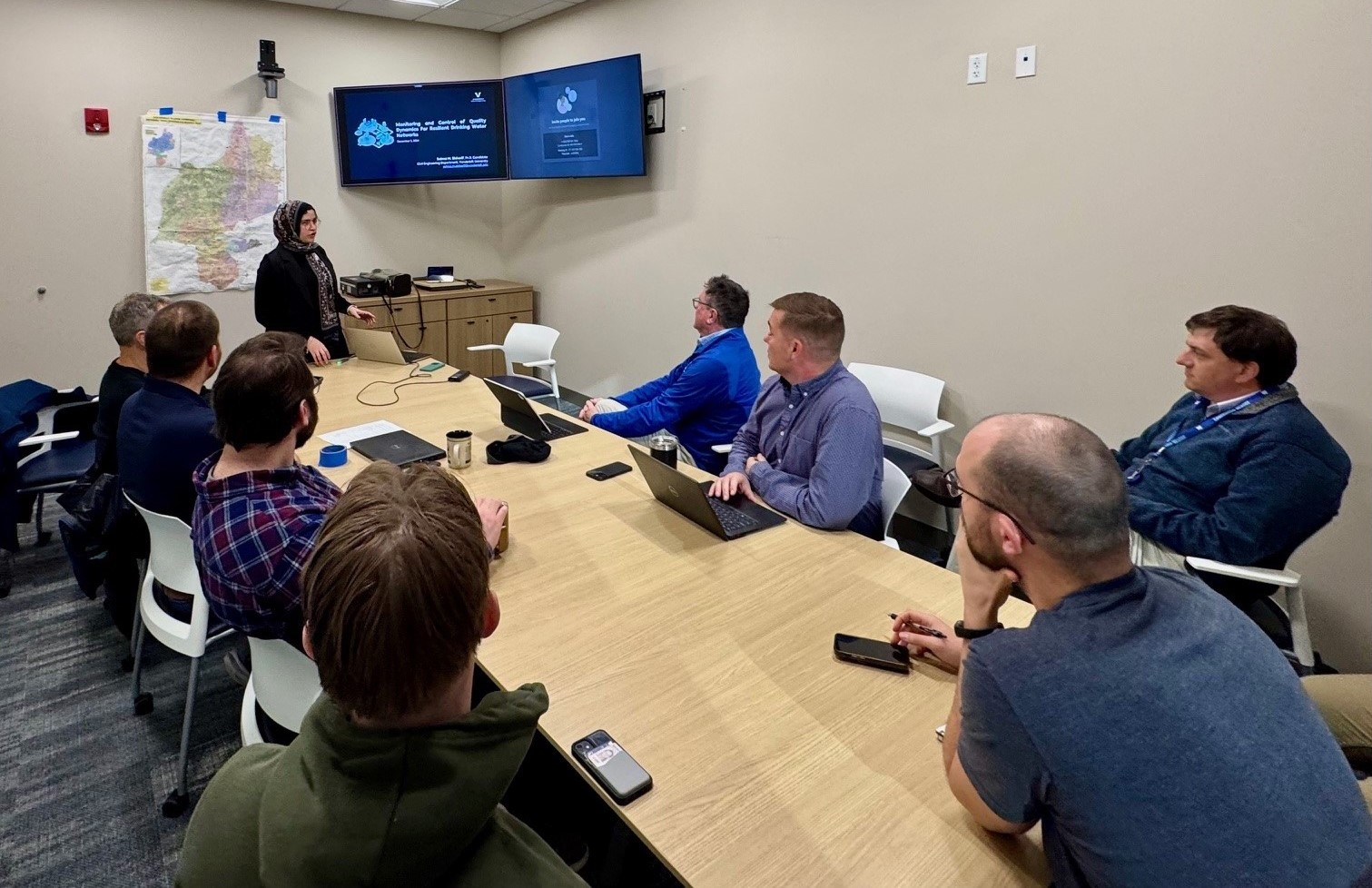
Presenting to the Louisville Water Company team, December 2024 -
Disinfectant Control in Drinking Water Networks: Integrating Advection-Dispersion-Reaction Models and Byproduct Constraints
Water Research
PaperAbstract
Effective disinfection is essential for maintaining water quality standards in distribution networks. Chlorination, as the most used technique, ensures safe water by maintaining sufficient chlorine residuals but also leads to the formation of disinfection byproducts (DBPs). These DBPs pose health risks, highlighting the need for chlorine injection control (CIC) by booster stations to balance safety and DBPs formation. Prior studies have followed various approaches to address this research problem. However, most of these studies overlook the changing flow conditions and their influence on the evolution of the chlorine and DBPs concentrations by integrating simplified transport-reaction models into CIC. In contrast, this paper proposes a novel CIC method that: (i) integrates multi-species dynamics, (ii) allows for a more accurate representation of the reaction dynamics of chlorine, other substances, and the resulting DBPs formation, and (iii) optimizes for the regulation of chlorine concentrations subject to EPA mandates thereby mitigating network-wide DBPs formation. The novelty of this study lies in its incorporation of time-dependent controllability analysis that captures the control coverage of each booster station. The effectiveness of the proposed CIC method is demonstrated through its application and validation via numerical case studies on different water networks with varying scales, initial conditions, and parameters.
-
Quality-Aware Hydraulic Control in Drinking Water Networks via Controllability Proxies
PreprintAbstract
The operation of water distribution networks is a complex procedure aimed at efficiently delivering consumers with adequate water quantity while ensuring its safe quality. An added challenge is the dependency of the water quality dynamics on the system's hydraulics, which influences the performance of the water quality controller. Prior research has addressed either solving the optimum operational hydraulic setting problem or regulating the water quality dynamics as separate problems. Additionally, there have been efforts to couple these two problems and solve one compact problem resulting in trade-offs between the contradictory objectives. In contrast, this paper takes a novel approach by examining the water quality dependency on the hydraulics from a control-theoretic standpoint. More specifically, we explore the influence of accountability for water quality controllability improvement when addressing the pump scheduling problem. We examine its effects on the cumulative cost of the interconnected systems as well as the subsequent performance of the water quality controller. To achieve this, we develop a framework that incorporates different controllability metrics within the operational hydraulic optimization problem; its aim is attaining an adequate level of water quality control across the system. We assess the aforementioned aspects' performance on various scaled networks with a wide range of numerical scenarios.
-
Water Quality Controllability Metrics, Limitations, and Hydraulic Dependencies
EWRI Congress
Abstract
Efficient water quality (WQ) control in distribution networks is pivotal for ensuring the delivery of safe and clean drinking water to consumers. Attaining this goal is complex due to the inherent intricacies of WQ systems, which often pose substantial challenges to achieving full controllability over their dynamics. Controllability, in this context, refers to the ability to effectively steer, regulate, and maintain disinfectant levels within the network to consistently meet the established water health standards. In addition, hydraulic conditions play a crucial role in influencing the level of WQ controllability. Hydraulic settings, including flow rates and directions, pressures, and network components, have a direct impact on how water quality dynamics propagate thereby influencing its controllability. In this study, we explore various metrics that provide both qualitative and quantitative assessments of water quality systems controllability. We examine the applicability of these metrics to the water quality systems taking into consideration network topology, booster stations’ locations, and changes in hydraulic settings. By applying a comprehensive framework to various case studies, we assess the performance, practicality, and limitations of these metrics across different network configurations and scenarios. The outcomes of this assessment not only enable water system operators to evaluate the state of system controllability but also provide a pathway for leveraging these metrics to enhance the efficiency and effectiveness of control and regulation strategies.
-
On Placement of Water Quality Sensors for Nonlinear Multi-Species Models in Drinking Networks
EWRI Congress
Abstract
The real-time monitoring of water distribution networks enables water quality (WQ) controllers to trace the evolution of disinfectants and contaminants within the network. Water quality sensors are typically employed within the network to achieve an observable system. However, the expensiveness of sensors along with their installation requires sensors to be optimally placed at certain location of the network. Prior research has approached solving the optimal geographic placement of WQ sensors from an objective-based approach that either assign different public health metrics related to contamination events, and network-wide observability-based metrics to obtain the optimal sensor selection. However, such methods have typically adopted the use of simplified single-species decay and reaction models; the resulting sensor placements are not robust to changes in the network’s hydraulic profile or advanced WQ models that capture far more than chlorine decay. To that end, in this work we introduce a state-robust observability-based sensor selection framework. The underlying water network model is based on a multi-species reaction dynamics representation; it enables contaminant reactivity modeling. The proposed sensor placement framework offers the following: (i) a robust solution towards fluctuations in water demand patterns; (ii) a scalable algorithm that enables its applicability to large-scale networks. A comprehensive case study is provided on benchmark water networks with varying hydraulic conditions. The sensor placement framework is solved considering several system observability metrics. This offers different observations that water system operators can consider.
-
Smarter Pump Scheduling Can Improve Water Quality Dynamics in Distribution Networks
EWRI Congress
Abstract
In drinking water networks, hydraulics and water quality stand out as two paramount phenomena, each with its distinct focus and time-scale. Hydraulics is concerned with delivering adequate pressure throughout the network, ensuring that water flows efficiently to meet consumers' needs. On the other hand, water quality focuses on the maintenance of high standards for water safety within the network. These two critical aspects operate on distinct time-scales. Hydraulics undergo changes on a longer time-scale, reflecting the gradual shifts in flow rates and pressure levels across the network. In contrast, water quality dynamics require faster measures, often necessitating the computation of hydraulic profiles in advance. That is, a layer of complexity arises from the interdependency of the water quality dynamics on the system’s hydraulics. This interdependence significantly impacts the performance of the water quality control and regulation algorithm in response to hydraulic adjustments. Prior studies have tended to focus on the two problems separately; Some studies have focused on optimizing the operational hydraulic settings, while others have concentrated on regulating water quality dynamics. Moreover, other studies have coupled these two problems leading to trade-offs between conflicting objectives. In this study, we adopt a control-theoretic perspective to investigate the intricate relationship between optimized hydraulic operation and water quality control. Our proposed framework explores the enhancement of water quality controllability while solving the pump schedule optimization problem. We examine the resultant trade-offs of the operational scheduling problem in comparison to the decoupled approach—and evaluate the impact on the water quality control performance. We assess and validate the proposed approach on various case studies with different scales and hydraulic scenarios. This study offers novel approaches to the integration of hydraulic and water quality control, paving the way for more effective and resource-efficient management of water distribution networks.
-
Water Quality Controllability Metrics, Limitations, and Hydraulic Dependencies
World Environmental and Water Resources Congress
PaperAbstract
Efficient water quality (WQ) control in distribution networks is pivotal for ensuring the delivery of safe and clean drinking water to consumers. Attaining this goal is complex due to the inherent intricacies of WQ systems, which often pose substantial challenges to achieving full controllability over their dynamics. Controllability, in this context, refers to the ability to effectively steer, regulate, and maintain disinfectant levels within the network to consistently meet the established water health standards. In addition, hydraulic conditions play a crucial role in influencing the level of WQ controllability. Hydraulic settings, including flow rates and directions, pressures, and network components, have a direct impact on how water quality dynamics propagate thereby influencing its controllability. In this study, we explore various metrics that provide both qualitative and quantitative assessments of water quality systems controllability. We examine the applicability of these metrics to the water quality systems taking into consideration network topology, booster stations’ locations, and changes in hydraulic settings. By applying a comprehensive framework to various case studies, we assess the performance, practicality, and limitations of these metrics across different network configurations and scenarios. The outcomes of this assessment not only enable water system operators to evaluate the state of system controllability but also provide a pathway for leveraging these metrics to enhance the efficiency and effectiveness of control and regulation strategies.
-
Comprehensive Framework for Controlling Nonlinear Multispecies Water Quality Dynamics
Journal of Water Resources Planning and Management
PaperAbstract
Tracing disinfectant (e.g., chlorine) and contaminants evolution in water networks requires the solution of one-dimensional (1D) advection-reaction (AR) partial differential equations (PDEs). With the absence of analytical solutions in many scenarios, numerical solutions require high-resolution time and space discretizations, resulting in large model dimensions. This adds complexity to the water quality control problem. In addition, considering multispecies water quality dynamics rather than the single-species dynamics produces a more accurate description of the reaction dynamics under abnormal hazardous conditions (e.g., contamination events). Yet, these dynamics introduce a nonlinear reaction formulation to the model. To that end, solving nonlinear 1D AR PDEs in real time is critical to achieving monitoring and control goals for various scaled networks with a high computational burden. In this work, we propose a novel comprehensive framework to overcome the large-dimensionality issue by introducing different approaches for applying model order reduction (MOR) algorithms to the nonlinear system followed by applying a real-time water quality regulation algorithm that is based on an advanced model to maintain desirable disinfectant levels in water networks under multispecies dynamics. The performance of this framework is validated using rigorous numerical case studies under a wide range of scenarios demonstrating the challenges associated with regulating water quality under such conditions.
-
Model Order Reduction of Nonlinear Multi-Species Water Quality Dynamics
EWRI Congress
Abstract
Tracing disinfectant (e.g., chlorine) and contaminants evolution in water networks requires the solution of 1-D advection-reaction (AR) partial differential equations (PDEs). While analytical solutions are non-existent in most cases, numerical solutions require high-resolution time- and space-discretizations. This results in large model dimensions even for small networks thereby leading to a physical-driven model that is intractable when considering constrained control and water quality regulation algorithms. In addition, considering multi-species rather than single-species dynamics produces a more accurate description of the reaction dynamics. The multi-species model can be used to model disinfectant interactions with other species (e.g., microbial, chemical) in the bulk flow, attached to the pipe walls, or contamination events. Yet, it adds complexity by introducing nonlinear reaction dynamics to the model. To that end, solving nonlinear 1-D AR PDEs in real time is critical in achieving monitoring and control goals for various scaled networks with a high computational burden. In this work, we propose a comprehensive framework to overcome the large-dimensionality issue by introducing different approaches for applying model order reduction (MOR) algorithms to the nonlinear system followed by applying feedback control to maintain desirable disinfectant levels in water networks. These approaches focus on reducing model dimension by orders of magnitude while preserving important properties of the original system (e.g., controllability). That is, this framework is constructed and tested considering different variables and parameters including hydraulics, network size, events nature, etc. Moreover, it is considered a generalized scalable framework in the sense that simplifications are included to consider single-species water dynamics and differentiations are suggested to consider different chlorine linear/nonlinear decay and reaction models. The performance of this framework is validated using rigorous numerical case studies under a wide range of scenarios demonstrating the challenges associated with controlling chlorine levels under multi-species water quality dynamics.
-
Control-Theoretic Modeling of Multi-Species Water Quality Dynamics in Drinking Water Networks: Survey, Methods, and Test Cases
Annual Reviews in Control
PaperAbstract
Chlorine is a widely used disinfectant and proxy for water quality (WQ) monitoring in water distribution networks (WDN). Chlorine-based WQ regulation and control aim to maintain pathogen-free water. Chlorine residual evolution within WDN is commonly modeled using the typical single-species decay and reaction dynamics that account for network-wide, spatiotemporal chlorine concentrations only. Prior studies have proposed more advanced and accurate descriptions via multi-species dynamics. This paper presents a host of novel state-space, control-theoretic representations of multi-species water quality dynamics. These representations describe decay, reaction, and transport of chlorine and a fictitious reactive substance to reflect realistic complex scenarios in WDN. Such dynamics are simulated over space- and time-discretized grids of the transport partial differential equation and the nonlinear reaction ordinary differential equation. To that end, this paper (i) provides a full description on how to formulate a high fidelity model-driven state-space representation of the multi-species water quality dynamics and (ii) investigates the applicability and performance of different Eulerian-based schemes (Lax–Wendroff, backward Euler, Crank–Nicolson, and Implicit Upwind) and Lagrangian-based schemes (Method of Characteristics) in contrast with EPANET and its EPANET-MSX extension. Numerical case studies reveal that the Implicit Upwind scheme, Method of Characteristics, and Lax–Wendroff scheme outperform other schemes with reliable results under reasonable assumptions and limitations.
-
Investigating Observability and Controllability of Water Quality Dynamics in Water Networks
INFORMS Annual Meeting, IN
PresentationAbstract
Water distribution networks (WDN) are considered vulnerable to health violations and contamination events. To better predict such events, a real-time dynamic model—based on PDEs that capture transport and reaction of contamiants and disinfectants—can be instrumented. Such model is essentially a dynamic- and network-theoretic representation of water quality (WQ) states throughout a WDN. Although this model has been thoroughly studied in the recent literature, its control-theoretic properties (stability, controllability, and observability) are neither studied nor understood. Consequently, the objective of this work is to investigate and understand control-theoretic properties of WQ models in drinking WDN. This understanding yields improved placement of decontamination stations, WQ sensors, and ultimately better real-time regulation of water quality.
Nothing matches these filters.